
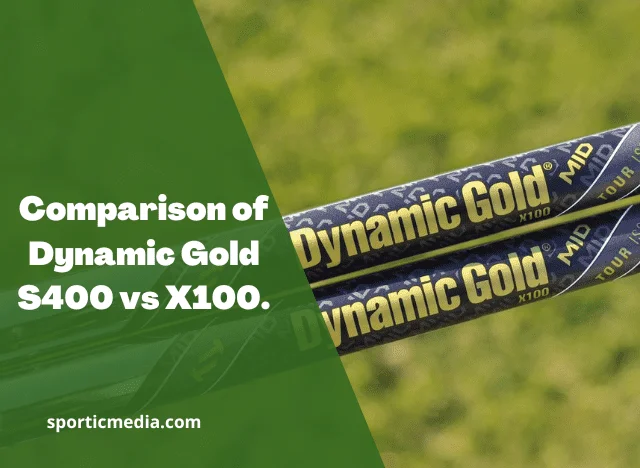
The True Temper Dynamic Gold range is the most widely played iron shaft in professional golf — and has been for decades. But within that range, the S400 and X100 create more confusion than almost any other shaft decision in the game. They look almost identical.
They’re made by the same company. They’re both heavy, low-launching, low-spinning steel shafts. And yet choosing the wrong one between them is a meaningful mistake that will affect every iron shot you hit.
The confusion largely comes from a naming system that doesn’t work the way most golfers expect. Once you understand how True Temper actually sorts these shafts — and what the numbers and letters really mean — the comparison becomes much clearer. This guide explains everything.
Table of Contents
First, Understand the Dynamic Gold Naming System
The Dynamic Gold naming system trips up golfers constantly because it looks like it should follow a simple logic — higher number means stiffer or heavier — but it doesn’t work that way.
In the Dynamic Gold family, the letter denotes flex and the number denotes weight sort, not additional stiffness. As Fit My Golf Clubs explains in their Dynamic Gold shaft chart, the R, S, and X designations are the flex categories — Regular, Stiff, and X-Stiff — while the number (200, 300, 400) indicates where within that flex the shaft sits in terms of weight.
This is because True Temper uses a weight-sorting tolerance of plus or minus two grams during production. Shafts that come in slightly lighter are designated S200 (~127g), those at the target weight are S300 (~130g), and those that come in slightly heavier are designated S400 (~134g) — all the same stiff flex, just different weight sorts.
This is why the X100 (~130g) can actually weigh less than the S400 (~134g) while being a stiffer shaft. Flex and weight are sorted independently. Once that clicks, the whole comparison makes sense.
Specifications at a Glance
| Specification | Dynamic Gold S400 | Dynamic Gold X100 |
|---|---|---|
| Flex | Stiff (heavy sort) | X-Stiff |
| Weight (iron) | ~134g | ~130g |
| Launch | Low | Low |
| Spin | Low | Low |
| Kick Point | High | High-Mid |
| Tip Diameter | 0.355″ | 0.355″ |
| Butt Diameter | 0.600″ | 0.600″ |
| Ball Flight | Low, penetrating | Low, penetrating |
| Ideal 6-iron speed | 85–95 mph | 95+ mph |
| Tour Issue available? | Yes | Yes |
Both shafts are available in standard and Tour Issue versions. The Tour Issue versions are produced to a weight tolerance of plus or minus half a gram — the tightest tolerance in the steel shaft industry — and are the versions used by tour professionals including Scottie Scheffler, Tiger Woods, and Justin Thomas.
The Core Difference: Flex, Not Just Weight
The most important distinction between the S400 and X100 is flex, not weight — even though weight is what most golfers fixate on.
The X100 is a genuinely stiffer shaft than the S400. It doesn’t flex as much through the swing, which means it resists torque better, keeps the face more stable through impact, and delivers a more consistent, lower-trajectory ball flight for golfers who generate enough speed to benefit from that extra stiffness.
The S400, while heavier, is a stiff flex shaft. It has more flex through the swing than the X100, which is precisely why many tour professionals — even fast-swinging ones — choose it over the X100. The additional weight gives the control and stability they want, while the stiff (rather than extra-stiff) flex allows a small amount of feel and load through impact that many players prefer for iron play.
As noted in Golf.com’s True Temper Tour Issue shaft breakdown, even Luke Donald — known for a controlled, smooth swing rather than an aggressive one — has played S400 Tour Issue, which illustrates that the S400 is not simply the “slower swing speed” option by default.
Weight: The Counterintuitive Part
The S400 is heavier than the X100. That surprises most golfers who assume the extra-stiff option would be the heavier one.
The practical implications of this weight difference:
Heavier shaft (S400 at ~134g):
- Promotes a slower, more controlled tempo through impact
- Increases the total weight of the assembled club, which some players use for feel and feedback
- Slightly reduces swing speed potential compared to a lighter shaft
- Preferred by players who want to feel the club head through impact rather than rely purely on flex feedback
Lighter shaft (X100 at ~130g):
- Allows slightly more swing speed due to reduced mass
- Still very heavy by any objective measure — this is not a lightweight shaft
- The stiffness compensates for the reduced weight in terms of control
- Preferred by players who want maximum stiffness with slightly lower total club weight
The 4-gram difference sounds negligible, but at this weight range — where both shafts are already 130g+ — the difference in feel is perceptible to golfers who are sensitive to club weight. For most recreational golfers, however, the flex difference will be more impactful than the weight difference.
Feel and Feedback at Impact
Both shafts are known for delivering excellent feel and feedback — this is one of the reasons Dynamic Gold has remained the benchmark for tour iron shafts for so long. But there are real differences in how they feel.
The S400 feels slightly more lively through impact. Because it has a fraction more flex than the X100, there’s a subtle load-and-release sensation in the mid-to-tip section that gives players the feeling of the shaft working.
As one reviewer from Golf Blue Heron’s comparison overview noted, the S400 doesn’t feel as stiff as its weight suggests — it has a faint but present kick point activity that activates on a powerful swing, delivering a responsive sensation without being flimsy.
The X100 feels stouter and more planted through impact. There’s less perceptible flex, which creates the sensation of the shaft transmitting energy very directly from hands to clubhead without any intermediate movement. For players who prefer this direct, firm sensation — or whose swings are fast enough that any softness in the shaft creates timing issues — the X100 is the right choice.
In practical terms: the S400 feels heavier; the X100 feels stiffer. Both of those feelings are accurate, because both of those things are true.
Launch and Ball Flight: What to Expect
Both shafts share the same low-launch, low-spin profile that defines the Dynamic Gold family. Neither is going to help a golfer who struggles to get the ball airborne — for that, shafts like the Dynamic Gold Mid or AMT are more appropriate.
What separates them in ball flight is subtle but measurable:
- The X100’s greater stiffness reduces the amount of shaft deflection at impact, which produces a slightly lower, more penetrating trajectory with very tight dispersion
- The S400’s additional weight and slightly more active profile can produce a marginally higher apex and slightly more spin — still low by most standards, but enough to affect how the ball lands and stops on greens
For golfers who already hit the ball too high and whose iron shots balloon in the wind, the X100’s stiffer profile can be genuinely beneficial. For golfers who want the low, controlled Dynamic Gold trajectory but with a touch more feel and feedback, the S400 delivers that without giving up meaningful control.
Stepping: A Practical Option Between S400 and X100
One option that experienced club builders use when a golfer falls between the S400 and X100 in terms of swing characteristics is shaft stepping — either soft-stepping or hard-stepping.
- Soft-stepping the X100 (installing each shaft one iron position longer than standard) effectively makes the X100 play slightly softer, bringing it closer to an S400 in flex feel while retaining the X100’s lighter weight
- Hard-stepping the S400 (installing each shaft one iron position shorter) makes the S400 play slightly stiffer, bringing it closer to an X100 in flex performance while keeping the S400’s heavier weight
As a Titleist Team member confirmed in a Titleist community forum thread, there is virtually no noticeable performance difference in ball flight between a hard-stepped S400 and a soft-stepped X100 — the difference that remains is primarily in feel, with the S400 playing heavier and the X100 playing lighter. This makes shaft stepping a legitimate tool for golfers who want to fine-tune their Dynamic Gold experience without committing to one shaft model exclusively.
Who Should Play Each Shaft?
The Dynamic Gold S400 suits you if:
- Your 6-iron swing speed is in the 85–95 mph range
- You want extra stiff-adjacent performance with the feel of a heavier shaft
- You prefer a shaft that feels planted and substantial at impact
- You’re transitioning from S300 and want more weight without jumping to X-stiff flex
- You play wedge-heavy golf and want consistent feel from irons into wedges (many tour players use S400 in wedges even when playing X100 in long irons)
The Dynamic Gold X100 suits you if:
- Your 6-iron swing speed is consistently 95 mph and above
- You want maximum stiffness to prevent any unwanted shaft flex at high speed
- You prefer a slightly lighter club with a firmer, more direct impact sensation
- You have a quick, aggressive transition that demands a stiff tip to keep the face square through impact
- You’re already comfortable with heavy steel shafts and want to step up in stiffness
The grey zone (90–95 mph 6-iron speed): At this speed, both shafts are workable. A shaft fitting with a launch monitor will tell you definitively which produces better numbers for your specific swing tempo, transition, and release pattern. As several community members have noted on Golf Monthly’s forum, swing tempo matters as much as swing speed — a faster tempo at 90 mph may legitimately fit the X100 better than a smoother tempo at 95 mph.
Dynamic Gold S400 vs X100 in the Context of the Full DG Family
It helps to see these two shafts in the context of what else True Temper offers, so you know whether you’re even in the right weight class:
| Shaft | Weight | Flex | Best For |
|---|---|---|---|
| Dynamic Gold Mid 90 | 90g | R/S/X | Mid-high launch; players stepping into DG from lighter shafts |
| Dynamic Gold S200 | ~127g | Stiff (light) | High-swing-speed players who want lighter DG weight |
| Dynamic Gold S300 | ~130g | Stiff (standard) | The benchmark DG stiff — most common for 90–105 mph |
| Dynamic Gold S400 | ~134g | Stiff (heavy) | Fast swingers wanting more weight, stiff flex |
| Dynamic Gold X100 | ~130g | X-Stiff | Very fast swingers needing maximum stiffness |
| Dynamic Gold Tour Issue | 130/132g | S400 / X100 | Tour players; tighter weight tolerance than standard |
If you’re currently in S300 and want to make a move, the S400 is the logical next step up in weight. The X100 is the step up in stiffness. If you need both — more weight and more stiffness — that’s where the Tour Issue versions with their tighter tolerances offer the most precise fit.
Frequently Asked Questions
Is the S400 stiffer than the S300?
No — the S400 is the same stiff flex as the S300 and S200. The number indicates the weight sort: S400 at ~134g is the heaviest of the stiff shafts. Stiffness within the S designation is essentially the same across S200, S300, and S400.
Is the X100 heavier than the S400?
No — the S400 is actually heavier (~134g vs ~130g for the X100). This surprises many golfers because they assume the extra-stiff option is always the heavier shaft. In the Dynamic Gold system, flex and weight are sorted independently.
What swing speed do I need for the X100?
Most fitters recommend the X100 for golfers with a 6-iron swing speed of 95 mph and above. As a rough driver speed conversion, that equates to approximately 105–115 mph with the driver. Below that, the S400 is generally the better fit.
Can I use S400 in my irons and X100 in my wedges?
Most fitters actually recommend the opposite — using S400 in wedges and X100 in long irons, or keeping the same shaft throughout for consistency. Some tour professionals use S400 in their wedges when gaming X100 in their irons, as the additional weight in the wedge is helpful for partial shots and feel around the greens.
What is the Tour Issue version and is it worth it?
Tour Issue Dynamic Gold (both S400 and X100) is manufactured to a weight tolerance of plus or minus half a gram — four times tighter than the standard version’s two-gram tolerance. The performance profile and materials are identical.
The Tour Issue is worth considering for low-handicap and scratch players who are highly sensitive to shaft-to-shaft consistency across a set, and for anyone building a set where matching feel across all irons is critical.
Final Verdict
The Dynamic Gold S400 and X100 are both excellent iron shafts built on the same legendary platform — low-launch, low-spin, high-feedback steel that has equipped tour winners for generations. The choice between them is genuinely about matching the shaft to your swing, not about one being categorically better than the other.
If your 6-iron speed is below 95 mph or you want a heavier, slightly more forgiving stiff shaft, the S400 is your shaft. If you’re swinging 95 mph and above with a quick, aggressive transition that demands maximum stiffness, the X100 is the correct tool. And if you’re genuinely in between, a proper fitting session — or a conversation with a club builder about soft-stepping or hard-stepping — will close that gap precisely.
One thing both shafts share: they will outlast almost any iron head you put them in, and they’ll tell you the truth about every swing you make. That’s the Dynamic Gold promise — and it holds across the entire range.
Discover the meticulous and expert-driven process behind our product reviews at Sportic Media. Our comprehensive guide, led by industry veterans, ensures you get the most reliable and detailed insights into golf equipment. Dive into our methodical approach by visiting How We Test Products at Sportic Media: A Comprehensive Guide
.


One Comment