If you can hit your irons reasonably well but suddenly struggle when you pull the driver from the bag, you are not alone. The driver is the longest club in the bag, has the lowest loft, and is designed to be struck from a tee with an upward angle of attack. Small setup or swing errors can therefore produce much larger misses than they would with an iron.
The good news is that you usually do not need to rebuild your entire golf swing.
PGA Professionals commonly look first at the fundamentals: ball position, tee height, alignment, grip, clubface, swing path, angle of attack, and strike location. PGA coaching guidance specifically emphasizes getting the ball forward enough, creating the correct shoulder tilt, and positioning the low point behind the ball to help produce an upward strike with the driver.
This guide explains why you may be struggling with your driver and what a professional golfer or PGA Coach would typically check first.
Table of Contents
Why Is the Driver Harder to Hit Than an Iron?
The driver is fundamentally different from your irons.
An iron is normally struck from the ground with a descending or relatively neutral attack, while the driver is teed up and is commonly optimized with an ascending angle of attack.
The driver is also longer and has less loft than most other clubs. That means small changes in:
- Face angle
- Swing path
- Strike location
- Ball position
- Tee height
- Angle of attack
- Club delivery
can produce large changes in launch, spin, direction and distance.
The Three Things That Control Your Driver Shot
A useful way to diagnose a poor drive is to separate the problem into three areas:
| Factor | What It Controls |
|---|---|
| Clubface | Starting direction and a major portion of curvature |
| Swing path | Direction the club is traveling through impact |
| Strike location | Ball speed, spin and launch efficiency |
If the ball starts in the wrong direction, look closely at the clubface.
If it starts reasonably well but curves dramatically, look at the relationship between the face and swing path.
If it starts reasonably straight but flies unusually short, investigate strike location, launch, spin and speed.
Your Driver Setup May Be the Problem
One of the first things a PGA Professional will check is your setup.
A poor setup can make the correct swing much harder to produce.
Check Your Ball Position
For a right-handed golfer, the driver should generally be positioned around the inside of the lead heel rather than in the middle of the stance.
PGA coaching guidance recommends a forward ball position because the driver needs to be struck later in the swing arc than an iron.
If the ball is too far back, you can encourage a downward strike and change the face and path relationship.
If it is excessively far forward, you may catch the ball too late in the arc.
Simple Ball-Position Check
Place the driver behind the ball and set your feet together.
Position the ball approximately opposite the inside of your lead foot, then widen your stance without moving the ball.
This gives you a repeatable starting reference.
Check Your Tee Height
Tee height affects where the ball is contacted on the clubface and can influence launch and spin.
A commonly recommended starting point is to have approximately half of the golf ball above the top of the driver crown.
That is a starting point rather than a universal rule. Your ideal tee height depends on your driver head, attack angle and strike pattern.
If you consistently strike the ball low on the face, experimenting with slightly more tee height can be useful.
Check Your Stance Width
Your driver stance should provide enough stability without restricting your rotation.
A stance slightly wider than your iron stance is a useful starting point.
PGA guidance for driver setup also emphasizes a stable stance and a slight tilt of the trail shoulder below the lead shoulder.
Get Your Shoulder Tilt Right
At address, your trail shoulder should sit slightly lower than your lead shoulder.
This happens naturally to some extent because your trail hand is lower on the grip.
Do not exaggerate the tilt.
The goal is simply to create a setup that allows the club to approach the ball from the appropriate part of the swing arc.
Why Do I Slice My Driver?
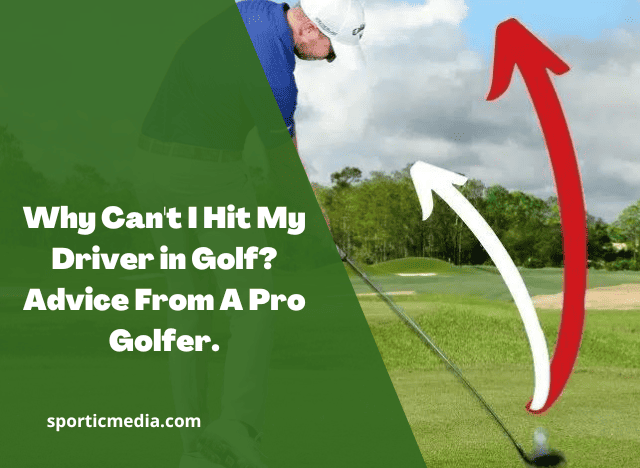
The slice is one of the most common reasons golfers believe they cannot hit their driver.
A typical slice for a right-handed golfer starts left, straight or right of the target and then curves significantly to the right.
PGA coaching sources identify a combination of an open clubface and an out-to-in swing path as common causes of the slice.
Your Clubface May Be Too Open
The clubface has a major influence on the ball’s starting direction and curvature.
If the face is substantially open relative to your swing path, the ball can curve strongly to the right for a right-handed player.
Do not immediately try to fix this by swinging harder.
First check whether the clubface is actually returning to a usable position at impact.
Your Swing Path May Be Too Far Out-to-In
An out-to-in path means the club is traveling across the target line from outside toward the inside through impact.
Combined with an open face, this can produce the classic high, weak slice.
PGA instruction specifically points to the out-to-in path as a common slice pattern and recommends working on the relationship between the trail elbow, club path and clubface.
Don’t Aim Farther Left to Fix a Slice
This is one of the most common mistakes.
If you keep aiming farther left because the ball curves right, you may unintentionally encourage an even more leftward swing path.
PGA Professional Vinnie Manginelli specifically warns against simply aiming farther left to compensate for a slice.
Instead, work on the underlying face and path relationship.
Why Do I Hit My Driver Straight but Only 150 or 200 Yards?
If your driver is relatively straight but lacks distance, the problem may not be accuracy.
Look at clubhead speed, strike location, launch angle and spin rate.
You May Not Be Striking the Center
A driver can lose substantial performance when impact moves away from the optimal area of the face.
Use impact tape, foot spray or a launch monitor to find your actual strike pattern.
If most of your strikes are:
- Low on the face
- High on the face
- Toward the heel
- Toward the toe
you may be leaving significant ball speed and distance on the table.
Your Launch May Be Too Low
A low launch can reduce carry distance even when the ball appears to fly straight.
Golfers with insufficient launch may benefit from:
- More appropriate driver loft
- Better ball position
- Higher tee height
- A more suitable attack angle
- Proper equipment fitting
PGA guidance notes that ball position, tee height and driver loft are important variables when optimizing launch.
Your Spin May Be Too High
The opposite problem is excessive spin.
A drive can launch reasonably high but climb excessively and lose forward momentum.
If your ball rises high and appears to stop rather than carry forward, a launch-monitor session can determine whether excessive spin is contributing to the distance problem.
You May Simply Need More Clubhead Speed
Distance ultimately requires sufficient speed.
But trying to swing violently is usually not the best way to create it.
A better goal is to develop speed while maintaining centered contact and a repeatable delivery.
Why Do I Top or Pop Up My Driver?
A topped drive or very high pop-up is often a strike problem rather than simply a “bad swing.”
Topping the Ball
A topped shot can occur when the bottom of the swing or the clubface delivery is poorly matched to the ball position.
Check:
- Ball position
- Tee height
- Posture
- Balance
- Head movement
- Strike location
Do not automatically try to keep your head completely still.
The objective is a functional pivot and centered strike, not an artificially frozen body.
Popping the Ball Up
A skyed drive usually indicates that the ball has been struck excessively high on the face, often toward the crown.
Check whether the tee is too high for your setup and whether your posture changes significantly during the swing.
A higher tee is not automatically better.
Why Can’t I Hit My Driver But I Can Hit My Irons?
This is extremely common.
The mistake is assuming that the driver should be swung exactly like a 7-iron.
The Driver Requires a Different Setup
The driver is:
- Longer
- Less lofted
- Teed above the ground
- Normally played farther forward
- Intended to be struck with a different point in the swing arc
PGA coaching advice specifically emphasizes the distinction between the driver strike and an iron strike.
Don’t Try to Hit Down on the Driver
Many golfers who struggle with driver distance instinctively try to hit down harder.
That can produce:
- Low launch
- Excessive spin
- Poor contact
- Reduced carry
- Pulls and slices
Instead, establish the correct setup and allow the club to move through the ball naturally.
Your Iron Swing May Be Too Dominant
If you are accustomed to hitting irons, you may instinctively move the ball backward and lean the handle forward.
That is useful for many iron shots but is not the same driver setup.
The driver is designed to be struck from a tee, with the ball positioned forward and the clubhead moving upward through impact.
How to Fix Your Driver Slice
If your primary problem is a slice, don’t attempt five swing changes at once.
Start with the fundamentals.
Step 1: Square Your Alignment
Use an alignment stick or club on the ground to check your feet, hips and shoulders.
Poor alignment can make your swing compensate before you even start the backswing.
PGA coaching recommends using alignment tools to verify body and clubface alignment.
Step 2: Check Your Grip
A grip that makes it difficult for the hands and clubface to return square can contribute to an open face.
Don’t make your grip dramatically stronger without understanding your individual swing, but make sure the grip is neutral enough to allow the clubface to return squarely.
Step 3: Fix Your Ball Position
Start with the ball around the inside of your lead heel.
Do not keep moving it farther forward simply because you slice.
Step 4: Work on the Club Path
PGA Coach instruction commonly uses alignment-stick drills to help golfers develop a less extreme out-to-in path.
A simple range exercise is to place an alignment stick or headcover just outside and slightly behind the ball.
Make swings that avoid hitting the object.
The goal is not to force a dramatic inside-out swing. It is to give yourself feedback against an excessively outside-to-in approach.
What Should I Practice to Hit My Driver Better?
The fastest improvement usually comes from structured practice rather than simply hitting 50 drivers as hard as possible.
The Start-Line Drill
Start direction is one of the most useful pieces of feedback in driver practice.
PGA coaching recommends selecting a small intermediate target a few feet in front of the ball and trying to start the ball directly over that target.
How to Do It
- Choose a target in the distance.
- Pick a small intermediate target between the ball and the target.
- Align the clubface with that point.
- Make your normal swing.
- Observe where the ball starts.
- Adjust the clubface rather than immediately changing your entire swing.
The Three-Target Practice Drill
Hit 10 drives while focusing on three different goals:
| Balls | Focus |
| 1–3 | Start line |
| 4–6 | Center strike |
| 7–10 | Start line + strike |
Do not judge the session only by how far the ball travels.
A 240-yard drive that starts on your intended line and finishes in play may be more valuable than a 270-yard drive that finishes 30 yards into the rough.
When Should You Stop Trying to Fix It Yourself?
If you have been making the same changes for months without improvement, it may be time to get professional feedback.
A PGA Professional can use:
- High-speed video
- Launch monitors
- Club data
- Face-to-path measurements
- Attack angle
- Dynamic loft
- Strike location
- Ball speed
- Spin rate
to determine what is actually happening rather than relying on guesswork.
Equipment can also be part of the problem.
PGA coaching specifically recommends getting properly fitted when equipment may not match the golfer’s body, swing or skill level.
Driver Fitting Can Reveal Problems You Cannot See
A launch monitor can tell you whether your problem is primarily:
| Data | Possible Problem |
| Low ball speed | Poor strike or insufficient clubhead speed |
| High spin | Excessive dynamic loft or strike issue |
| Very low spin | Insufficient launch or low-face/path interaction |
| High launch + high spin | Inefficient delivery |
| Large face-to-path gap | Excessive curvature |
| Large left/right dispersion | Face, path or strike inconsistency |
| Low launch | Ball position, loft or delivery issue |
This is far more useful than simply being told to “swing harder.”
A Simple Driver Checklist Before Every Tee Shot
Before hitting your driver, run through this short checklist.
Setup Checklist
- Ball approximately inside the lead heel
- Tee height consistent
- Stance slightly wider than an iron
- Trail shoulder slightly lower
- Clubface aimed at the intended start line
- Grip feels neutral and comfortable
- Weight balanced
- Target clearly identified
Swing Checklist
- Smooth takeaway
- Maintain width
- Avoid rushing the transition
- Allow the body to rotate
- Avoid trying to kill the ball
- Strike the ball rather than the ground
- Hold your finish
The PGA of America also emphasizes choosing a realistic landing area and a specific target rather than simply trying to hit the ball as far as possible.
Should You Always Hit Driver?
No.
This is one of the most important pieces of professional advice.
If the driver is putting you in serious trouble, there is nothing wrong with using a 3-wood, hybrid or iron from the tee.
Good course management is not about proving that you can hit the driver.
It is about putting your next shot in the best possible position.
PGA guidance recommends choosing a safe landing area, considering the trouble on the hole, and selecting the club that gives you the best chance of keeping the ball in play.
When to Leave the Driver in the Bag
Consider another club when:
- The fairway is extremely narrow
- Hazards are positioned around your normal driver landing area
- Your driver swing is currently unreliable
- A shorter club leaves you a comfortable approach
- You are playing a hole where accuracy is more valuable than maximum distance
That is not giving up.
It is smart golf.
Why Can’t I Hit My Driver? The Most Likely Causes
| Problem | Most Likely Areas to Check |
| Slice | Face angle, face-to-path relationship, alignment, swing path |
| Hook | Face-to-path relationship, grip, timing |
| Low drives | Ball position, launch, tee height, dynamic loft |
| Skyed drives | Tee height, posture, strike location |
| Topped drives | Strike location, posture, low-point control |
| Weak high shots | Strike, spin, launch |
| Straight but short | Ball speed, strike, launch and spin |
| Pulls | Alignment, face direction and swing path |
| Pushes | Face direction, path and delivery |
| Inconsistent contact | Setup, balance, posture and swing control |
Final Advice From a Pro-Golf Perspective
If you cannot hit your driver consistently, don’t assume that you need a completely new golf swing.
Start with the things that are easiest to verify:
ball position → tee height → alignment → grip → clubface → strike → swing path → launch and spin.
That sequence matters.
A golfer who changes the swing path before checking the setup can easily spend weeks trying to correct a problem that began with ball position or alignment.
And remember that the goal is not to hit every driver perfectly.
The goal is to produce a repeatable start line, predictable shot shape, useful distance and manageable dispersion.
Once you can do those four things, your driver becomes a scoring weapon rather than the club you are afraid to pull from the bag.
Frequently Asked Questions
Why can I hit my irons but not my driver?
The driver requires a different setup and delivery because it is longer, has less loft and is played from a tee. A ball position that works well for an iron can be too far back for the driver.
Why does my driver always slice?
A slice commonly results from an open clubface relative to the swing path, often combined with an out-to-in path. Check your alignment, grip, ball position, face angle and path before making major swing changes.
Should I move the ball farther forward if I slice?
Not necessarily. Start with a repeatable position around the inside of the lead heel and diagnose the actual cause of the slice.
Should I hit up on my driver?
An upward angle of attack can be beneficial for driver launch and distance, but you should not force an exaggerated upward motion. Correct setup and ball position make it easier to deliver the club appropriately.
Why does my driver go high but not far?
Excessive spin, poor strike location, insufficient ball speed or inefficient launch conditions can all contribute. A launch monitor is the quickest way to identify which variable is responsible.
Should beginners use a driver?
Yes, but beginners should not feel obligated to hit driver on every hole. A properly fitted, forgiving driver can be useful, but a shorter club may be the smarter choice when accuracy matters more than distance.
How do I hit my driver straighter?
Start by improving your setup and start line. Then identify whether the curvature is caused primarily by the clubface, swing path or both. Use simple feedback drills rather than trying to make several swing changes simultaneously.
How can I stop being afraid of hitting driver?
Practice the club in controlled situations rather than only using it during a round. Build confidence by focusing on a repeatable setup, a realistic target and a smooth swing instead of maximum effort.
Discover the meticulous and expert-driven process behind our product reviews at Sportic Media. Our comprehensive guide, led by industry veterans, ensures you get the most reliable and detailed insights into golf equipment. Dive into our methodical approach by visiting How We Test Products at Sportic Media: A Comprehensive Guide
.