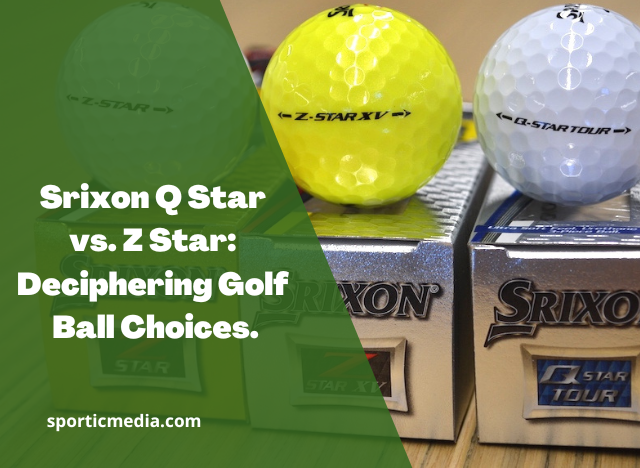
Walk into any pro shop and the Srixon golf ball range can look deceptively simple — a neat lineup with familiar names. But choosing between the Q-Star and the Z-Star is one of those decisions that actually matters.
Get it right and you’ll compress the ball cleaner, spin it better around the greens, and feel every shot the way you’re supposed to. Get it wrong and you’re either fighting a ball that’s too firm for your swing speed or leaving short-game performance on the table with a ball that’s too soft.
This guide breaks down exactly what separates the Q-Star Tour and the Z-Star — not just the specs, but what those specs mean on the course for real golfers.
The Short Answer: What’s the Key Difference?
The two balls share more than they don’t. Both are three-piece urethane-covered golf balls. Both use Srixon’s Spin Skin coating to generate greenside spin. Both feature the same 338 Speed Dimple aerodynamic pattern. They look nearly identical sitting in a sleeve.
The split comes down to one number: compression.
The biggest difference between Srixon’s Q-Star Tour and Z-Star comes down to compression — 74 versus 88 — and your swing speed determines which one actually performs. That gap of roughly 14 compression points isn’t cosmetic. It defines how the ball reacts at impact, who should be playing it, and what you’ll get from it on approach shots and around the greens.
Specs Head-to-Head
| Feature | Srixon Q-Star Tour | Srixon Z-Star |
|---|---|---|
| Construction | 3-piece | 3-piece |
| Cover | Soft urethane + Spin Skin | Urethane + Spin Skin+ |
| Compression | ~74 | ~88 |
| Feel | Softer | Soft (firm by tour standards) |
| Driver Spin | Low-Mid | Mid |
| Wedge Spin | Mid-High | High |
| Ideal Swing Speed | 75–95 mph | 90–105+ mph |
| Trajectory | Mid-High | Mid |
| Price (per dozen) | ~$40 | ~$50 |
Both balls were rebuilt for 2025 with redesigned core and cover constructions, plus a micro-urethane Spin Skin+ coating that delivers increased greenside spin — so both are performing better than their predecessors at their respective price points.
Compression Explained: Why It Actually Matters
Compression is a measure of how much the ball deflects at impact. Lower compression means more deflection, softer feel, and easier energy transfer for moderate swing speeds. Higher compression means less deflection and better energy transfer for faster swings that can push the ball hard enough to deform it properly.
Here’s the practical reality: if your driver swing speed sits below 90 mph, a firmer ball works against you. You won’t compress the Z-Star fully at impact, which means you lose both feel and distance. If your swing speed is consistently above 90 mph, the Q-Star Tour’s softer core can get over-compressed — leading to a balloon flight off the driver and less predictable spin numbers.
The important thing most golfers miss: the right compression doesn’t just improve feel — it improves distance. A ball matched to your swing speed transfers energy more efficiently at impact. Playing the wrong compression is like riding in the wrong gear.
According to Srixon’s official ball fitting selector, the Q-Star Tour is specifically designed for moderate swing speed performance, while the Z-Star targets players seeking maximum greenside spin at higher speeds.
Feel: Soft vs. Softer
In every area of the game, the Q-Star Tour’s defining characteristic is softness. With the putter, its urethane cover creates a buttery feedback at impact. The low compression keeps the feel soft and responsive through the long game too.
The Z-Star is also described as soft — but soft by tour standards, which means it’s noticeably firmer than the Q-Star Tour. On MyGolfSpy’s Ball Lab test, the Z-Star measured at 88 compression — qualifying as firm across the broader market, even though it’s considered approachable within the tour ball category.
If you’ve ever heard a golfer say a ball “feels like hitting a rock,” they were likely playing a high-compression ball their swing speed couldn’t properly load. The Z-Star doesn’t deserve that reputation — but it will feel noticeably firmer than the Q-Star Tour on putts, chips, and mid-irons, especially for players below 90 mph.
Greenside Spin and Short Game
This is where both balls genuinely shine — and where urethane covers earn their keep over ionomer alternatives.
Both the Q-Star Tour and the Z-Star use Spin Skin technology: a coating over the urethane cover that increases surface friction to grab the grooves and generate spin on partial shots, pitches, and chips. The degree of spin is where they differ.
The Z-Star produces the highest greenside spin in Srixon’s accessible lineup for faster swing speeds. At full wedge speeds, it generates more consistent and predictable spin rates than the Q-Star Tour — which matters for low handicappers who are trying to control exactly how much a ball checks up on different greens.
The Q-Star Tour, however, performs impressively close to the Z-Star in short-game spin for moderate swing speeds. At speeds where a player can’t fully compress the Z-Star, the Q-Star Tour can actually deliver better short-game performance — not worse. For a moderate-speed player, the lower compression makes the wedge interaction feel stickier and more controlled, which shows up in spin numbers rather than just feel.
- Z-Star wedge spin (independent tests): ~5,814 RPM
- Q-Star Tour wedge spin (moderate swing): Approximately 200–300 RPM below Z-Star at equivalent swing speed
- Q-Star Tour at its target swing speed: Often matches or exceeds Z-Star spin due to better compression match
Distance Off the Tee
Distance is the stat golfers obsess over, but the truth here is nuanced. Distance between the two balls is roughly equal for a golfer with a swing speed around 85–95 mph. In that range, you’re unlikely to notice a meaningful yardage difference off the driver.
What you will notice is that the Z-Star flies on a slightly lower, more penetrating trajectory with less spin — which means more roll-out on firm fairways but less stopping power on full approach shots.
Above 100 mph, the Z-Star pulls ahead in energy transfer and ball speed because the firmer core delivers a faster rebound. Below 85 mph, the Q-Star Tour is often longer because the softer core allows a moderate-speed swing to compress and release the ball more efficiently — you’re working with physics rather than against it.
Who Should Play Each Ball?
Play the Q-Star Tour if you:
- Swing the driver between 75 and 95 mph
- Want a urethane-covered, three-piece ball without the premium price tag
- Prioritise feel and short-game spin over raw ball speed
- Are a mid-to-high handicapper wanting a ball that helps rather than punishes
Play the Z-Star if you:
- Swing the driver at 90 mph and above, consistently
- Are a low-to-mid handicapper who needs maximum greenside spin
- Want the lowest driver spin in Srixon’s accessible range for a flatter, more penetrating ball flight
- Are regularly attacking flags from inside 150 yards and need the ball to stop quickly
The grey zone (85–95 mph): At this swing speed, the performance gap between the two balls narrows considerably. Both are valid choices. The Q-Star Tour makes more sense if you value feel and want to save money. The Z-Star makes more sense if you’re improving rapidly and want a ball that keeps rewarding you as your speed increases.
Where the Z-Star XV and Diamond Fit In
If you’re researching this comparison, it’s worth knowing where the Z-Star variants sit within Srixon’s full lineup:
| Model | Compression | Best For |
|---|---|---|
| Q-Star Tour | ~74 | Moderate swing speeds (75–95 mph), value |
| Z-Star | ~88 | Skilled players, 90–105 mph, control |
| Z-Star Diamond | ~100 | Aggressive players wanting max iron spin |
| Z-Star XV | ~102 | Fast swingers (100+ mph), distance |
The standard Z-Star is the most approachable option within the Z-Star family — positioned as a ball for better players who want top-tier performance without needing to swing at elite speeds. It’s often compared more accurately to the Chrome Soft than to the Pro V1x. At slower swing speeds, either the Z-Star or Q-Star Tour is far more sensible than reaching for the Diamond or XV.
Price and Value
The Q-Star Tour sits at around $40 per dozen, while the Z-Star runs closer to $50 per dozen in 2025. That $10 difference per dozen matters over a full season.
The Q-Star Tour’s Spin Skin coating and soft urethane cover deliver wedge spin within roughly 300 RPM of premium tour balls at less than 75% of the price — a genuinely compelling value case. You’re getting urethane short-game performance at a price point that used to belong to ionomer-covered distance balls.
For a mid-handicapper playing 25–30 rounds a year, the Q-Star Tour is arguably the smartest ball in the entire Srixon range — it punches well above its price bracket. The Z-Star is worth the premium only when your swing consistently demands it.
Common Mistakes Golfers Make When Choosing
Choosing by brand loyalty or tour association. Just because your favourite tour pro plays a Z-Star XV doesn’t mean the standard Z-Star — or even the Q-Star Tour — isn’t better suited to your swing speed.
Assuming firmer equals better performance. A higher-compression ball is only better if you can compress it. For most recreational golfers, the Q-Star Tour is the smarter choice — not the “cheaper” one.
Ignoring green conditions. If you play courses with firm, fast greens where stopping the ball is critical, greenside spin matters even more. Both balls serve you well here, but the Z-Star has an edge for players attacking from inside 100 yards at higher swing speeds.
Not testing with a launch monitor. A range session with a Trackman or similar device will tell you more in 20 minutes than any spec sheet. Many golf retailers offer free ball fitting sessions — it’s worth using them before committing to a ball for the season.
Frequently Asked Questions
Is the Srixon Q-Star Tour a tour-level ball? Yes — it uses a three-piece urethane construction with Spin Skin coating, which puts it in the same category as the TaylorMade Tour Response and Titleist Tour Soft. It’s not quite a Z-Star in overall performance at high swing speeds, but it’s a genuine tour-construction ball at a mid-range price.
What swing speed is the Srixon Z-Star designed for? Srixon positions the Z-Star for players around 90–105 mph with the driver. Independent testing broadly supports this, though some players at 85 mph and above will get good results from it depending on ball-striking consistency.
Can high handicappers use the Z-Star? They can, but most won’t benefit from it unless they also have a fast swing speed. A high handicapper with 85 mph or less of driver speed will typically get better feel, more distance, and more greenside control from the Q-Star Tour.
Which Srixon ball do tour professionals use? Most Srixon staff players have moved toward the Z-Star XV or Z-Star Diamond — the firmer, faster variants suited to elite swing speeds. Hideki Matsuyama used the 2025 Z-Star XV to break the PGA Tour’s 72-hole scoring record at The Sentry, which validated the current generation’s performance credentials.
Final Verdict
The Q-Star Tour and Z-Star are both excellent, well-engineered golf balls that share far more technology than their price difference suggests. The compression gap — 74 vs. 88 — is the defining variable, and your swing speed is the deciding factor.
If you swing at 90 mph and above, the Z-Star gives you better energy transfer, more consistent spin at speed, and the short-game precision that better players need. If you’re below 90 mph — which covers the majority of amateur golfers — the Q-Star Tour isn’t a consolation prize. It’s genuinely the better ball for your game, and at a lower price.
Match the ball to your swing speed, not your aspirations. That’s the simplest and most honest piece of golf ball fitting advice there is — and it applies here perfectly.
Discover the meticulous and expert-driven process behind our product reviews at Sportic Media. Our comprehensive guide, led by industry veterans, ensures you get the most reliable and detailed insights into golf equipment. Dive into our methodical approach by visiting How We Test Products at Sportic Media: A Comprehensive Guide
.